What is carrom?
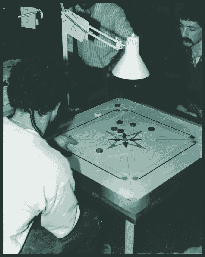
Like many games and sports, carrom originated in Asia, where it is a popular national pastime with around 200 million players.
The idea is similar to pool. The board is a smoothly polished, 74 × 74 cm maple playing surface surrounded by beechwood cushions. Instead of a cue, carrom uses a disc called a striker (also known as a “Fligg” in Switzerland). Two to four players aim to pocket nine white carrom men, nine black carrom men and one red piece — the queen — in the four corner pockets. The striker is flicked from the baseline to send the carrom men into the pockets. The first player to pocket their pieces, with the queen properly covered, wins.
Carrom calls for a delicate touch and tactical skill.
Standard equipment
(From the official carrom rules)
Standard equipment consists of:
- A) The carrom board
- B) The carrom men
- C) The striker
- D) The table or stand
- E) The chair or stool
- F) The powder
- G) The nets
- H) The lighting
A. The carrom board
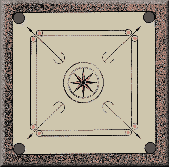
A.1 Playing surface
The playing surface should be made of plywood or a similarly smooth wood. It must be at least 8 mm thick and form a smooth square measuring between 73.5 and 74 cm on each side. A standard 15 g striker, struck with maximum force from a baseline towards the opposite cushion, should be able to travel across the playing surface at least 3½ times.
A.2 The frame
The playing surface should be surrounded by a frame made of rosewood or another hardwood with good rebound. Its inside corners should be rounded. Measured from the playing surface, the frame must be between 1.9 and 2.54 cm high and between 6.35 and 7.60 cm wide. Suitable supports should be fitted beneath the playing surface and attached to the frame.
A.3 The pockets
The corner pockets should be round, with a diameter of 4.45 cm and a maximum permitted variation of 0.15 cm. The wooden surface must be cut out at each pocket.
A.4 Baselines
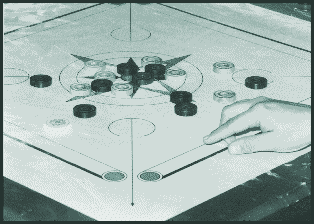
a) Two straight black lines, each 47 cm long, should be drawn parallel to the frame on each of the four sides. A variation of 0.30 cm is permitted, distributed evenly on all sides. The lower line should be between 0.50 and 0.65 cm wide and 10.15 cm from the frame. The second line should be 3.18 cm from the lower line.
b) The baselines should end in circles measuring 3.18 cm in diameter. Each should contain a red filled circle measuring 2.54 cm in diameter. These are called base circles. They should touch both baselines on their side as well as the imaginary extension of the upper baseline on the adjacent side. The distance between base circles on neighbouring sides is approximately 1.27 cm.
A.5 The arrows
Four black arrows, no more than 0.15 cm thick, should be drawn at the corners at an angle of 45 degrees to the sides. Each arrow passes between the base circles and points towards the centre of the pocket, with 5 cm between its tip and the pocket's edge. An arrow must not exceed 26.70 cm in length. A decorative arc measuring 6.35 cm in diameter, with a pointed end on each side facing the pockets, may be drawn at the arrow's starting point.
A.6 The centre circle
A black circle filled in red should be drawn exactly in the centre of the board. Its diameter should be 3.18 cm, with a maximum permitted variation of 0.16 cm. This is the centre circle.
A.7 The outer circle
A black circle measuring 17 cm in diameter should be drawn around the centre of the board, with a permitted variation of 0.30 cm. This is the outer circle. Decorative designs are permitted inside it.
B. The carrom men
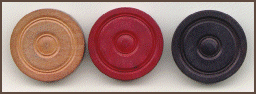
The carrom men should be round and made of good-quality wood. Their diameter must be between 3.02 and 3.18 cm, their thickness between 0.70 and 0.90 cm, and their weight between 5.00 and 5.50 g. Their edges should be rounded and even. A set consists of nine white, nine black and one red carrom man, all of identical construction. They should move flat and smoothly across the surface when struck with a standard striker.
C. The striker
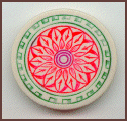
The striker should be round and even, with a maximum diameter of 4.13 cm and a maximum weight of 15.00 g. It may be made of any material except metal, provided it meets these specifications. Visible metal parts attached to the striker are not permitted. Engraved designs are allowed as long as they are not offensive.
D. The table or stand
The table or stand supporting the board should be between 63.00 and 70.00 cm high. The board must sit level and stable. Materials may be placed beneath the table or stand to level it.
E. The chair or stool
The player's chair or stool should be between 40.00 and 50.00 cm high. A chair must not have armrests.
F. The powder
Use good-quality powder to keep the playing surface smooth and dry. The powder must not be damp. A powder bag or container should be used to distribute it evenly across the playing surface.
G. The nets
Nets should be attached beneath the corner pockets. Each must have enough space for at least ten carrom men.
H. The lighting
A light should be positioned at a suitable height above the board. A cylindrical or square shade, preferably made of metal, should direct light only onto the playing surface and frame. The inside of the shade should be painted entirely white. The bulb, preferably clear glass, should be rated at 60–100 watts. At a player's request, the height may be adjusted so that neither player is dazzled.